https://www.nature.com/articles/s41550-018-0401-8

2018/01/18
BBFH 1957: Synthesis of the Elements in Stars
https://journals.aps.org/rmp/abstract/10.1103/RevModPhys.29.547
http://adsabs.harvard.edu/abs/1957RvMP...29..547B
http://adsabs.harvard.edu/abs/1957RvMP...29..547B
"It is the stars, The stars above us, govern our conditions"
King Lear
http://nfs.sparknotes.com/lear/page_220.html
"The fault, dear Brutus, is not in our stars, But in ourselves"
Julius Caesar
http://nfs.sparknotes.com/juliuscaesar/page_18.html
https://en.wikipedia.org/wiki/B2FH_paper
https://en.wikipedia.org/wiki/Fred_Hoyle
King Lear
http://nfs.sparknotes.com/lear/page_220.html
"The fault, dear Brutus, is not in our stars, But in ourselves"
Julius Caesar
http://nfs.sparknotes.com/juliuscaesar/page_18.html
https://en.wikipedia.org/wiki/B2FH_paper
https://en.wikipedia.org/wiki/Fred_Hoyle
2017/12/01

2017/03/24
2017/03/07
2017/01/22
The High-velocity System: Infall of a Giant Low-surface-brightness Galaxy toward the Center of the Perseus Cluster
http://adsabs.harvard.edu/abs/2015ApJ...814..101Y
 Figure 6. Channel maps for the main body (upper set of panels) and secondary body (lower set of panels). The heliocentric velocity of each channel is indicated. Notice the similar overall morphology of the main and secondary bodies in each panel separated by 120 km s−1. The cross in each panel marks the approximate geometrical center of the main body of the HVS. The white rectangle in the lower set of panels corresponds to the region where an outflow associated with the AGN in NGC 1275 is detected; this outflow produces a relatively strong and very broad component in the red wing of the [N ii]λ6583 Å line from NGC 1275, thus obscuring any line emission associated with the secondary body of the HVS. The angular resolution of the maps is 2
 7 at FWHM.
 7 at FWHM.
A very deep Chandra observation of the Perseus cluster: shocks, ripples and conduction
http://adsabs.harvard.edu/abs/2006MNRAS.366..417F
http://chandra.harvard.edu/photo/2005/perseus/

http://chandra.harvard.edu/photo/2005/perseus/
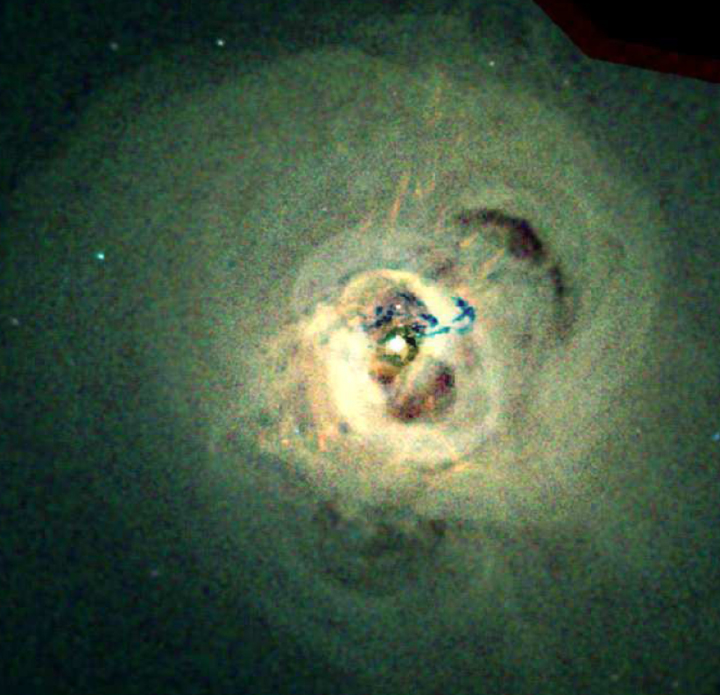
Fig.3 Colour image made from the 0.3–1.2 (red), 1.2–2 (green) and 2–7 keV (blue) bands. A 10-arcsec smoothed image has been scaled to 80 per cent of its intensity and then subtracted in order to bring out fainter features lost in the high-intensity range of raw images. The blue structure to the N of the nucleus is caused by absorption in the infalling high-velocity system, We suspect that these arc-like pressure minima are old bubbles. projected at least 60 kpc in front of the nucleus of NGC 1275 (Gillmon, The large size of these bubbles could indicate that the activity was Sanders & Fabian 2004).
登録:
投稿 (Atom)