http://chandra.harvard.edu/photo/2005/perseus/
2017/01/22
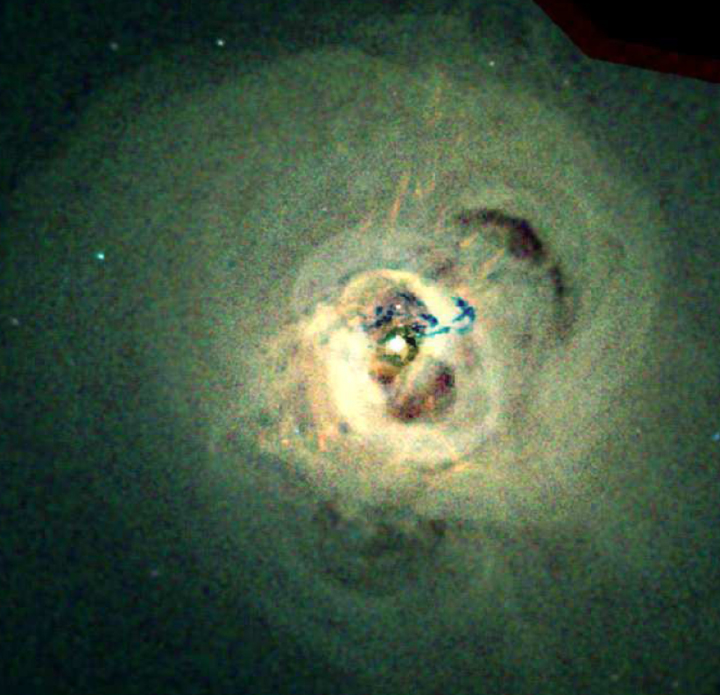
A very deep Chandra observation of the Perseus cluster: shocks, ripples and conduction
http://adsabs.harvard.edu/abs/2006MNRAS.366..417F
http://chandra.harvard.edu/photo/2005/perseus/
ラベル:
Chandra,
fabian,
perseis:HVS,
perseus
2015/12/08
Black Hole Blowback
http://www.scientificamerican.com/article/black-hole-blowback/
WALLACE TUCKER,
HARVEY TANANBAUM
AND ANDREW FABIAN
2007
WALLACE TUCKER,
HARVEY TANANBAUM
AND ANDREW FABIAN
2007
ラベル:
black-hole,
fabian,
scientific-american
2009/08/01
Serendipity in Astronomy
Fabian, 2009
12 pages with 10 figures. To be published in Serendipity (eds Mark de Rond and Iain Morley), CUP
http://arxiv.org/abs/0908.2784
12 pages with 10 figures. To be published in Serendipity (eds Mark de Rond and Iain Morley), CUP
http://arxiv.org/abs/0908.2784
2006/11/22
A very deep Chandra observation of the Perseus cluster: shocks, ripples and conduction
MNRAS, 2006
We present the first results from a very deep Chandra X-ray observation of the core of the Perseus cluster of galaxies. A pressure map reveals a clear thick band of high pressure around the inner radio bubbles. The gas in the band must be expanding outwards and the sharp front to it is identified as a shock front, yet we see no temperature jump across it; indeed, there is more soft emission behind the shock than in front of it. We conclude that in this inner region either thermal conduction operates efficiently or the co-existing relativistic plasma seen as the radio mini-halo is mediating the shock. If common, isothermal shocks in cluster cores mean that we cannot diagnose the expansion speed of radio bubbles from temperature measurements alone. They can at times expand more rapidly than currently assumed without producing significant regions of hot gas. Bubbles may also be significantly more energetic. The pressure ripples found in earlier images are identified as isothermal sound waves. A simple estimate based on their amplitude confirms that they can be an effective distributed heat source able to balance radiative cooling. We see multiphase gas with about 109Msolar at a temperature of about 0.5 keV. Much, but not all, of this X-ray emitting cooler gas is spatially associated with the optical filamentary nebula around the central galaxy, NGC1275. A residual cooling flow of about 50Msolaryr-1 may be taking place. A channel is found in the pressure map along the path of the bubbles, with indications found of outer bubbles. The channel connects in the south (S) with a curious cold front.
登録:
投稿 (Atom)