http://www.nikkei-science.com/201805_052.html
ニュートリノは電子型,ミュー型,タウ型の3種類の存在が知られる。それらの質量などに関する情報は,ニュートリノが飛行する間に種類が変わる「ニュートリノ振動」の実験によってかなりわかってきた。ただ一部のニュートリノ振動実験では,未知の種類の存在を示唆する結果が報告されている。他の実験結果との整合性を考えると,未知の種類は既知の3種類と違って,放射性元素の崩壊などを起こす「弱い力」が作用しない「ステライル型」だと考えられている。ステライル型が実在するのかどうか確かめるため,大強度陽子加速器施設「J-PARC」で大がかりな実験が年内にも始まる予定だ。
2018/04/19

2015/10/29

2015/10/20
Dark matter maps reveal cosmic scaffolding
Massey, 2007, Nature
http://www.nature.com/nature/journal/v445/n7125/full/nature05497.html
from COSMOS project

http://www.nature.com/nature/journal/v445/n7125/full/nature05497.html
from COSMOS project

2015/09/11
2015/08/20
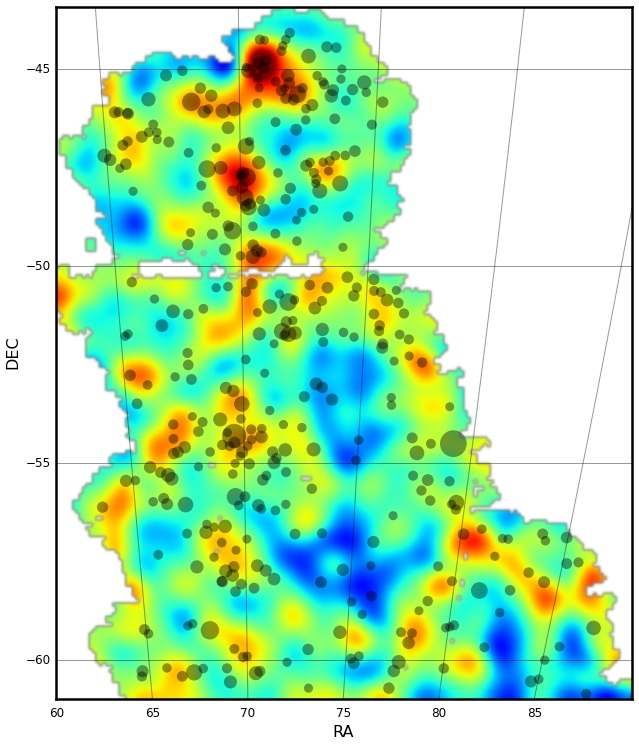
Wide-field lensing mass maps from Dark Energy Survey science verification data: Methodology and detailed analysis
http://adsabs.harvard.edu/cgi-bin/bib_query?arXiv:1504.03002
http://www.nature.com/news/dark-matter-mapped-at-cosmic-scale-1.17311
Weak gravitational lensing allows one to reconstruct the spatial distribution of the projected mass density across the sky. These "mass maps" provide a powerful tool for studying cosmology as they probe both luminous and dark matter. In this paper, we present a weak lensing mass map reconstructed from shear measurements in a 139 deg2 area from the Dark Energy Survey (DES) science verification data. We compare the distribution of mass with that of the foreground distribution of galaxies and clusters. The overdensities in the reconstructed map correlate well with the distribution of optically detected clusters. We demonstrate that candidate superclusters and voids along the line of sight can be identified, exploiting the tight scatter of the cluster photometric redshifts. We cross-correlate the mass map with a foreground magnitude-limited galaxy sample from the same data. Our measurement gives results consistent with mock catalogs from N -body simulations that include the primary sources of statistical uncertainties in the galaxy, lensing, and photo-z catalogs. The statistical significance of the cross-correlation is at the 6.8 σ level with 20 arcminute smoothing. We find that the contribution of systematics to the lensing mass maps is generally within measurement uncertainties. In this work, we analyze less than 3% of the final area that will be mapped by the DES; the tools and analysis techniques developed in this paper can be applied to forthcoming larger data sets from the survey.

http://www.nature.com/news/dark-matter-mapped-at-cosmic-scale-1.17311
Weak gravitational lensing allows one to reconstruct the spatial distribution of the projected mass density across the sky. These "mass maps" provide a powerful tool for studying cosmology as they probe both luminous and dark matter. In this paper, we present a weak lensing mass map reconstructed from shear measurements in a 139 deg2 area from the Dark Energy Survey (DES) science verification data. We compare the distribution of mass with that of the foreground distribution of galaxies and clusters. The overdensities in the reconstructed map correlate well with the distribution of optically detected clusters. We demonstrate that candidate superclusters and voids along the line of sight can be identified, exploiting the tight scatter of the cluster photometric redshifts. We cross-correlate the mass map with a foreground magnitude-limited galaxy sample from the same data. Our measurement gives results consistent with mock catalogs from N -body simulations that include the primary sources of statistical uncertainties in the galaxy, lensing, and photo-z catalogs. The statistical significance of the cross-correlation is at the 6.8 σ level with 20 arcminute smoothing. We find that the contribution of systematics to the lensing mass maps is generally within measurement uncertainties. In this work, we analyze less than 3% of the final area that will be mapped by the DES; the tools and analysis techniques developed in this paper can be applied to forthcoming larger data sets from the survey.
登録:
投稿 (Atom)